
Stage Curtains
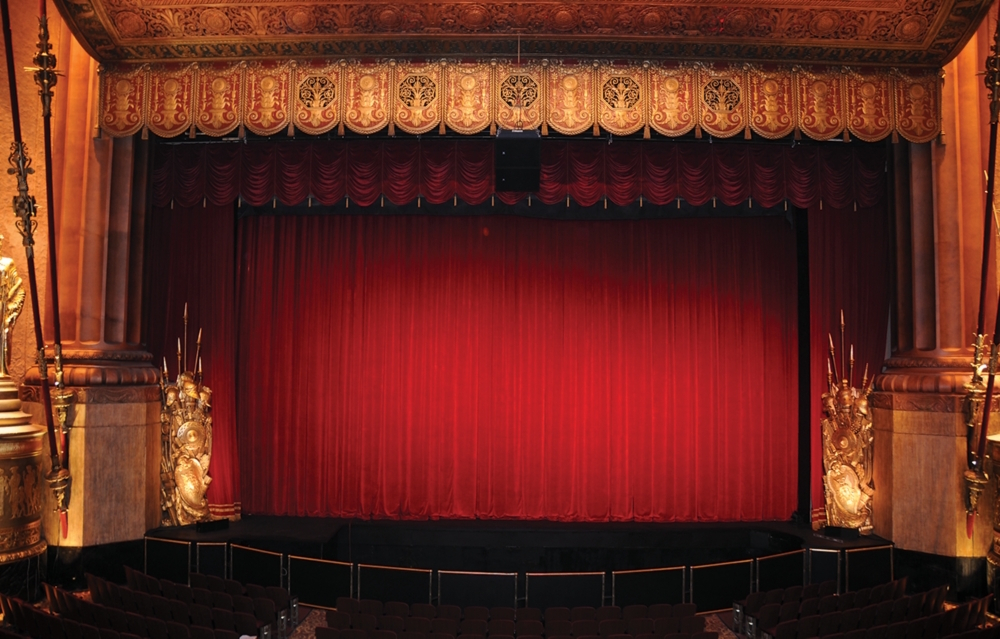
Main stage curtains (i.e., grand drapes) are usually the largest and most ornate curtains in the theater. We bring decades of experience to both large and small stage curtain projects, so you can rely on us whether you’re an industry pro or a novice. Whether you’re sourcing theater curtains for sale for a new installation or upgrading an existing space, selecting the right curtain system is critical to both performance and presentation.
Design Support for New Installs and Upgrades
Let us help you design, specify, and budget the right soft goods for your stage production, special event, film, or video. Know that we also manufacture movie theater drapes, as well as the finest quality PVC and fabric projections screens. Check out our project portfolio for inspiration and to learn more about our experience. It shows our expertise in stage curtains, event draperies, scenic backdrops, and projection screens. From traditional grand drapes to modern open stage curtains, our team can guide you through the options that best fit your venue and production needs.
Explore Curtain Styles and See Examples
See below for different types of main stage drapes along with demonstrations of each. Contact us at 800-223-1624 or customerservice@rosebrand.com for more information. If you're ready to request a quote, use our online quote request form.
For those who are less familiar with stage curtain types and theater production terminology, we offer the following stage layout and callouts of the various curtains that might be found on a stage.
Stage Layout
Main Curtains (also called proscenium, act, grand, front, or house curtains) refer to the full height curtains and their valance that are closest to the proscenium opening. They are normally used to open and close the view of the stage, making them a central component when evaluating custom theater curtains for sale.
Masking Curtains are typically black or a dark color and designed to conceal the backstage from the audience's sight lines, especially in professional environments.
Backdrops are sewn flat and often seamless. They create a flat surface for painting, digital images, or projection. A cyc or cyclorama is a specific type of backdrop used for lighting effects.
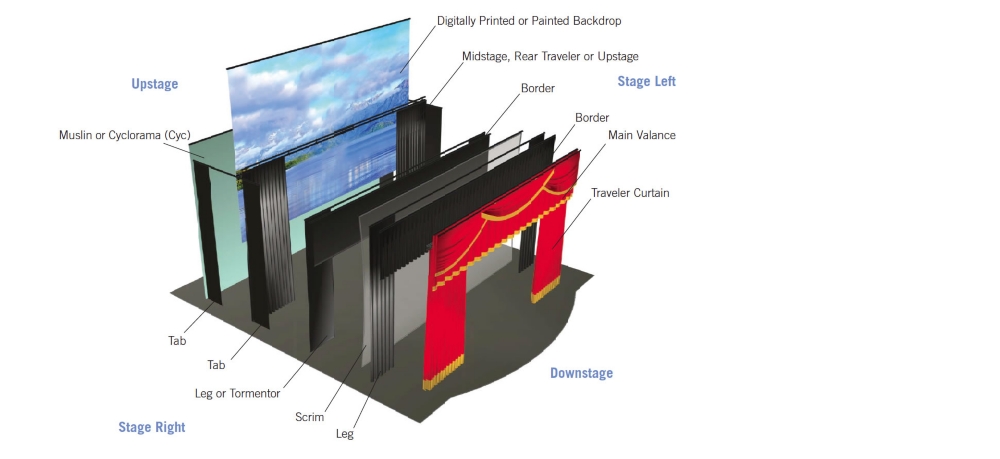
Main Curtains
- Main Valance
- Main Traveler Curtain
- Tab (Tableau) Curtain
- Austrian Curtain
- Brail
- Venetian Curtain
- Venetian Contour Curtain
- Brail
- Roman Shade
Masking Curtains
- Borders or Teasers
- Legs or Tormentors
- Midstage or Rear Traveler
- Tabs
Backdrops
- Digitally Printed or Painted Backdrop
- Scrim
- Muslin or Leno Cyclorama (Cyc)
- Projection Screen (not shown)
- ShowLED Star Drop (not shown)
Stage Curtain Types
See below for various types of custom theatre curtains for sale. Simple functioning curtains, such as Travelers, may be found in every type of venue. More elaborate curtains, such as Austrians and Venetians, are more commonly found in major professional theatres.
Traveler Curtain
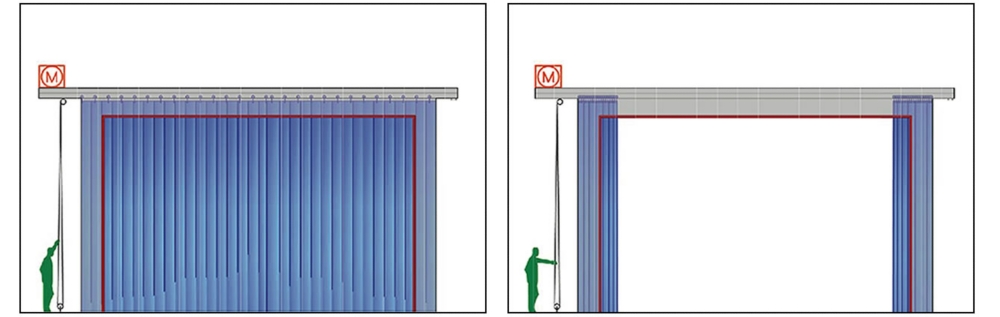
The traveler or bi-parting curtain is made of two overlapping panels, customarily in 100% fullness. The panels are hung on overlapping traveler tracks. Smaller, lightweight curtains can be operated manually. Larger heavier curtains must be motorized. See the demo.
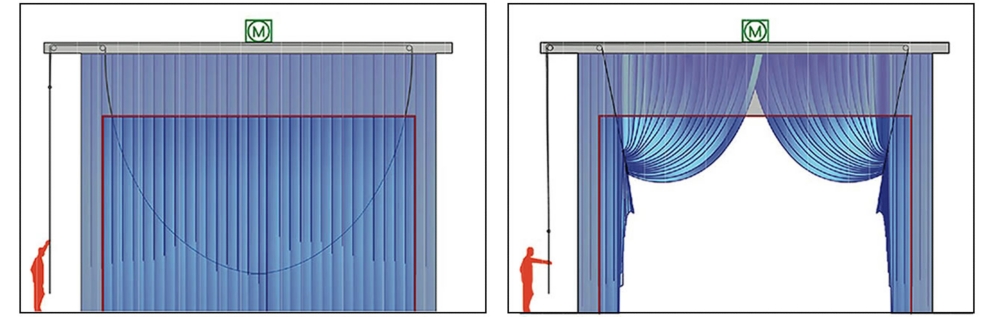
Tab (Tableau) Curtain
Made of two overlapping panels, usually in 50-150% fullness. Rings are sewn on the back, starting from the lower on-stage edge. A line runs through the rings to pull the leading edge of the curtain out and open to form a swag. Tabs work best when each half’s height is greater than its width. Smaller lightweight tab curtains can be operated manually depending on the rigging. Larger heavier curtains must be motorized. See the demo.
Austrian Curtain
Made up of a series of vertical panels with both horizontal and vertical fullness. The curtain is raised evenly from the bottom by a series of lift lines that run through rings sewn on the seams between panels. Very small lightweight Austrian curtains can be operated manually depending on the rigging. Larger, heavier curtains must be motorized. The vertical stack height when raised will be 20% or more of the overall height. Due to its horizontal fullness, side guides or spreader pipes are used to prevent an Austrian from "hourglassing". See the demo.
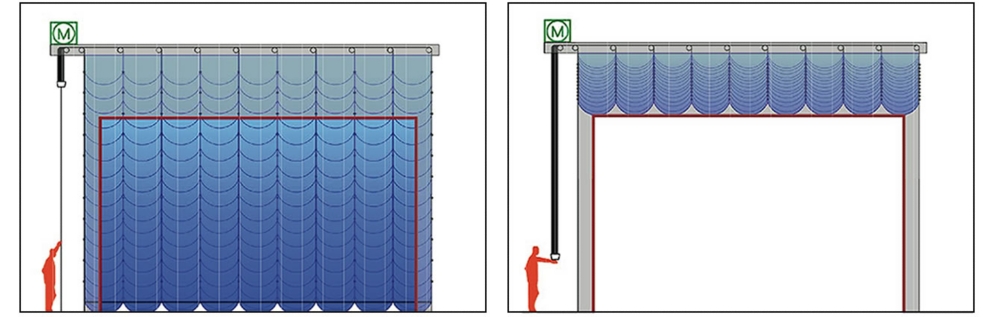
Brail Curtain
The brail curtain is a flat curtain built with vertical fabric panels. Rings are sewn into the seams on the back. A single pipe at or near the bottom is raised by a series of ropes or cables that run through the rings. The fabric folds onto itself as the pipe is raised. Very small lightweight brail curtains can be operated manually depending on the rigging. Larger, heavier curtains must be motorized. See the demo.
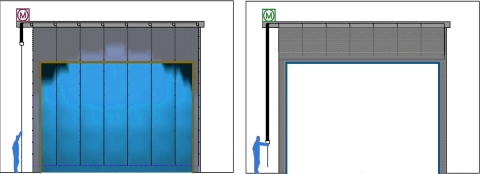
Venetian Curtain
When in its lowered position, it looks like a standard drape in fullness. Ring and lift lines on the seams raise the Venetian from the bottom to form a graceful, scalloped profile. Very small, lightweight Venetian curtains can be operated manually depending on the rigging. Larger, heavier curtains must be motorized. The vertical stack height when raised will be a minimum of 20% of the overall height. See the demo, particularly for those who are evaluating more elaborate custom theatre curtains for sale.
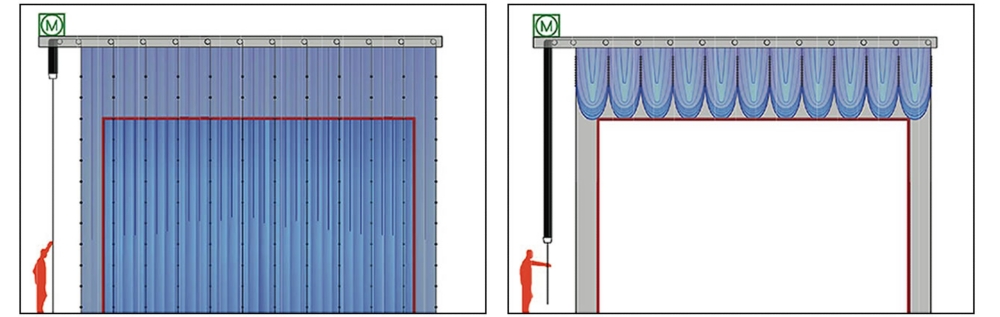
Venetian Contour Curtain
Has individually operated lift lines that allow for multiple profiles. The shape of the profile depends on the placement of the ring lines and curtain fullness which varies by panel to accommodate the contour shape. Venetian contours cannot be operated manually. A motor and control are needed for each lift line. See the demo.
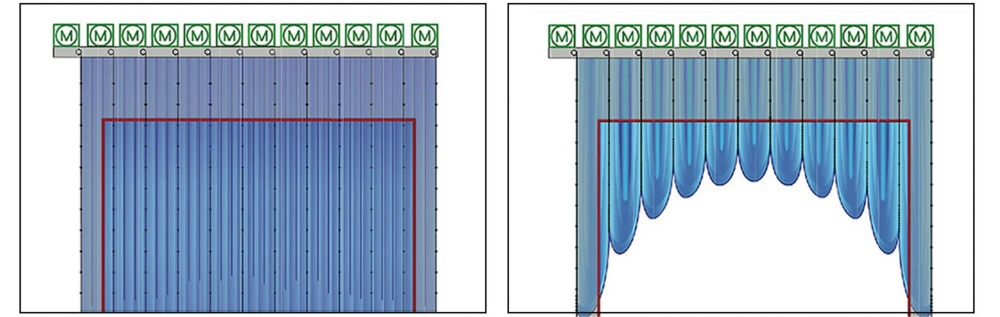
Roman Shade Curtain
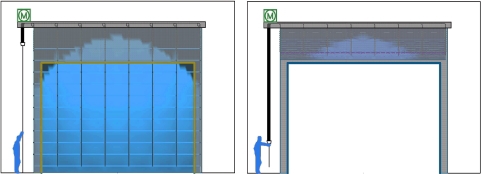
The Roman shade is a flat curtain, built with horizontal panels of fabric with pipe pockets on the back at the seams. (Not ideal for fabrics with nap or direction.) A series of ropes or cables run through rings on the back of the pipe pockets, lift the pipes in sequence, and create horizontal accordion folds in the curtain as the bottom is raised. Very small, lightweight Roman shades can be operated manually depending on the rigging. Larger, heavier curtains must be motorized. Note that Rose Brand also manufactures curtain track, motors, controllers, and automation systems, along with custom curtains for sale.
FAQs
What types of theater curtains for sale does Rose Brand offer?
Rose Brand offers a full range of theater curtains, including main curtains, masking curtains, and backdrops. Options include traveler curtains, Austrian curtains, Venetian curtains, and other systems designed for professional stage use.
Can I order custom theater curtains for my venue?
Yes. Rose Brand specializes in custom theater curtains built to your exact specifications. Each solution is tailored to your space and production needs.
How do I choose the right stage curtain system?
The right system depends on both subjective factors such as desired curtain aesthetics and level of automation, as well as objective factors such as dimensions of the stage, wings & fly space, curtain weight, proscenium infrastructure, and more.