
October 12th, 2016 | 5 min read
How to Clean Your Curtains, Cycs & Nettings
Important Considerations When Cleaning Natural & Synthetic Fiber Products

Customers often ask us how to clean their curtains, cycs and nettings. While cleaning is important to maintain the look of these products, it also helps to maintain their flame retardancy characteristics. Here are some important considerations when cleaning natural and synthetic fiber products.
Natural Fiber Products
Dry cleaning is a good option for curtains, cycs and nettings that are made of natural fiber fabrics (cotton, cotton/poly blends, linen, jute, silk). Since natural fiber products used in public spaces have all been treated with a water soluble flame retardant chemical, washing these materials in a water based solution will remove the FR (flame retardant) additive. This presents a fire safety hazard and would likely cause failure of any fire safety inspection.
Dry cleaning, on the other hand, will help preserve the flame resistant qualities of your treated fabric. However, the effectiveness of the FR chemical will diminish with each dry cleaning. Depending on the fabric, the flame retardancy may become insufficient after as few as three dry cleanings, yet other fabrics may retain effective flame resistance after a dozen dry cleanings.
Using the standard match field test from the National Fire Protection Association (NFPA 705), which is provided at the bottom of this article, test the fabric before and after the dry cleaning to gauge any change in flame resistance. If the flame resistance is no longer effective, retreat the fabric with a flame retardant chemical solution spray.
Since flame resistance is affected by water, large fluctuations in the humidity of the venue in which the fabric is used could also adversely affect the flame resistance of the fabric. High humidity can wash away the flame resistance additive from sections of a drape, again causing an unsafe environment. Your flame resistance products should be tested periodically, and retreated as necessary, to insure that you continue to meet the required safety standard.
Synthetic Fabric Products
Cleaning your synthetic velour draperies requires a slightly different approach. Both synthetic and natural fiber drapes will accumulate dust which works to diminish their flame retardancy, but this is particularly true for synthetics. Synthetics carry a slight electromagnetic charge (static), which serves as a dust magnet. Your dust is not flame retardant.
If you are cleaning drapes periodically then you should clean them at least once a year in order to get the dust out. Vacuuming is the best option by a long shot. Be sure to vacuum both front and back, top to bottom.
A viable, and often easier, alternate to vacuuming is to “blow” off the curtains using pressurized air from an air compressor hose. Essentially, all you do is “hose down” the front and back (from top to bottom) of each curtain. The frequency at which you do this will vary by the conditions of your environment and can range from monthly to annually. If your curtains are very dirty, you might vacuum them initially and then follow up with a maintenance schedule of regular air blowing. We also recommend adequate eye protection for this process and caution against using air pressure in working environments as it will blow dust and debris around.
If these methods do not work for you then we suggest sweeping down the drapes, front and back. Make sure to use a clean broom and the broom should be used only for drapes and not used for anything but sweeping the drapes. Finally, vigorous shaking or “rug” beating is better than nothing.
Try to remove minor stains or paint marks using warm water. However, caution should be used with any stain remover as it may affect the color of the fabric. Pretest a small, low visibility area first.
For major cleaning, you may water wash your IFR curtains in a machine or tub. Use only mild detergents such as Woolite. Never use bleach or softeners, which may adversely affect the natural flame retardancy of the fabric. You may tumble dry at up to 140° F, but remove immediately and hang. No ironing is required. Dry cleaning is also acceptable but make sure your cleaning service air dries or dries only at very low temperatures. For all drapes, air drying while hanging in place works best. On-site dry cleaning services are becoming more available, so check internet listings.
Standard Match Field Test, NFPA 705
-
Cut two representative samples of your fabric or film, each rectangle approximately 1" wide by 5" long (ed. note: NFPA 705 calls for 1’ wide strips, but 2” wider yields a test that more closely approximates the lab results).
-
The long side of the first cut sample should be oriented with the vertical (height) of your fabric. The other sample should be oriented with the horizontal (width) of your fabric. In other words, the second rectangular piece is cut at a 90° angle to the first.
-
Find a safe place for testing-the space and floor must be clear of burnable materials, particularly draperies, fabrics, paper, wood and sawdust. Also find a place free of drafts.
-
Have a fire extinguisher close at hand, a source of water (sink), or a bucket of water.
-
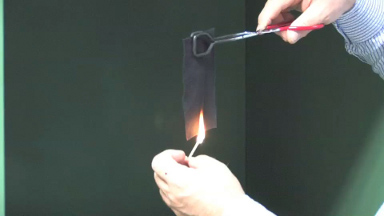
Suspend each sample vertically, the short edge at the bottom. Metal tongs or pliers work well to keep fingers out of the test.
-
Using a standard, wooden kitchen match, apply the tip of the flame to the center of the bottom edge of the suspended sample. Maintain the flame steadily in the initial position beneath the edge of the fabric for 12 seconds. The position of the flame should not move up to stay in contact with the edge of the fabric as it burns away.
-
Only if no wooden match is available, use a lighter. Lighters burn at much hotter temperatures than wood, but we find that we get similar results no matter the flame sourceAll fabrics burn to some extent. You should expect some burning. As the sample burns or chars (blackens) or melts, the tip of your flame remains stationary- do not move up the flame you are holding, as the material burns or melts away. Your match simulates the fixed position of a Bunsen burner from the lab-it does not move during testing.
-
After 12 seconds, remove the match and blow it out well away from the specimen sample.
-
Continue to observe your specimen. Any flame on the specimen must self extinguish within 2 seconds after you remove the match. If any flame has extinguished before the removal of the match, even better.
-
Any glowing (afterglow) along the burnt edge of the fabric or any generation of smoke must stop completely within 20 seconds after the removal of the match.
-
If either of these limits is exceeded, your material is not sufficiently flame resistant to be safe. You need to re-treat or replace it with something better.
-
If your first specimen passes, then repeat this test for the second specimen.
-
Frequently, particularly with synthetics, you will find that one direction passes, but not the other. FR treatment or re-treatment or replacement is still in order, if only one specimen passes but not the other.
Recent Posts
One might think that a fabric company has little to do with lighting. After all, while scenery and lighting design are inexorably linked, how important can fabric be to either? Yet the choices a designer makes in fabric, as with all the other elements, will directly affect the final look of the production.
As high grade recording equipment becomes more affordable and non-linear editing software becomes more robust, even grade school children can now post high quality video content to YouTube on a regular basis.
You don't have to know every detail of your Stage Curtain to get a reliable budget estimate. This article covers the most important factors
Featured Posts
Scenic designers use Netting and Gauze fabrics in combination with other scenery and lighting to create visual illusions and spatial depth. The transparency of netting and the translucency of gauze make these fabrics particularly well suited for these effects. The following describes the characteristics of various nettings and gauzes and how you might use them to best effect.
Design, Specifications & Build Custom Services

We produce more stage & event curtains and backdrops than any other provider. Get a quote.

Email or call us at 800-223-1624 with a brief description of your project.

Use our Fabric Finder to easily search for any theatrical or event fabric